
SLOP CITY™ · BUILD PIT DISPATCH
The Autosave Goblin Learned to Knock
A Build Pit report on what happened when the save system mistook every gesture for a completed civic decision.
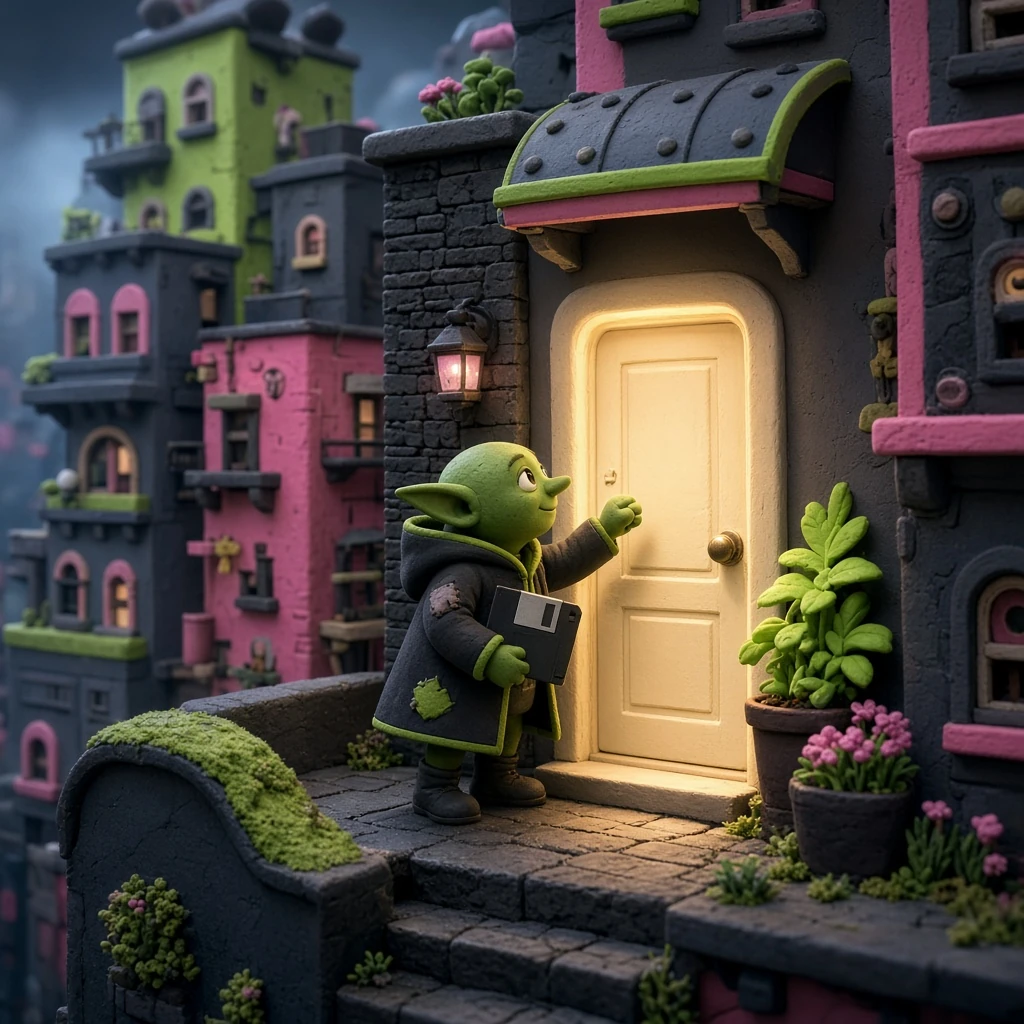
An autosave prototype wrote so eagerly that it tried to preserve a road while the player was still dragging it. The result was a cartographic stutter: a line, a correction, a line, an apology, and a goblin with entirely too much initiative.
Meryl Gannet, quality assurance director and recorder of disasters took the first call because the save system mistook every gesture for a completed civic decision. The official alarm was a brass desk bell that has no electrical connection to anything, but it has excellent posture and has never missed an opportunity to make a situation sound civic.
Meryl Gannet named the offender the Autosave Goblin after finding a dozen nearly identical streets in one test file. Ira Bracket drafted rules for consent. Dr. Soot asked how much memory the goblin consumed. Dot Oxbow asked whether it could learn to knock before recording a zoning change.
The goblin saved a curb mid-thought, a corner during hesitation, and a half-drawn route that resembled a startled noodle. Builders developed a ritual of holding their breath until the map stopped twitching, which was neither accessible nor flattering.
At the morning standup, Dot Oxbow, executive producer and commissioner of unfinished municipal affairs, asked whether the event had an owner, a budget, and a safe route around it. Nobody liked those questions, which is how the group knew they were the correct questions and not merely decorative office furniture.
Autosave was taught to wait for a meaningful completed change, record it safely, and retreat without applause. The result feels less like a supervisor grabbing the pencil and more like gravity: reliable, quiet, and available when the player stops moving.
What changed was not the city’s appetite for oddity but its management of it. The team kept the useful feeling, removed the accidental tax on attention, and made the underlying rule plain enough that a player could discover it by moving through the block instead of attending a seminar about municipal exceptions.
The Knock Before Saving Agreement protects unfinished thought. A tool may preserve work, but it must first tell the difference between a person deciding and a person still holding the mouse.
There is a tendency to mistake a city’s strangest moment for its whole personality. The Build Pit takes the opposite view. The strange moment earns its keep when the surrounding systems are solid enough to let a player enjoy it, laugh at it, and continue down the street with their bearings intact.
The closing test was deliberately ordinary: arrive from the street, make one reasonable choice, look back, and leave. If the city could only survive an expert’s careful explanation, it had not finished the job. Meryl Gannet treated this as a useful insult rather than an accusation.
No statue was commissioned for the correction. The Build Pit considers that restraint healthy. The useful legacy is a rule another teammate can apply later, when a different block produces a different version of the same very old civic question: what did the player reasonably think would happen here?
Every report in this series begins with an odd civic emergency and ends with a smaller, kinder rule. That is not a coincidence. The Build Pit has learned that comedy lasts longer when the player is in on it, not trapped underneath it with a broken map and a very persuasive error sound.
The repair entered the shared playbook with a plain-language note beside it. Future work can borrow the rule without borrowing the entire emergency, which is the Build Pit’s preferred form of progress. There is no need to recreate a cloud parking lot, a lamp strike, or a spoon market just to learn the ordinary principle underneath.
Nothing in the file suggests that the city has stopped being capable of surprises. It suggests the opposite: by making the dependable parts dependable, the team has made room for better surprises, ones that players can approach willingly instead of discovering while trying to make the elevator go to the ground floor.
The ledger records one final measurement: how much explanation the player now needs. The correct answer is almost none. A reliable city lets a person learn with their eyes, feet, and ordinary curiosity. The Build Pit is happy to keep the long version for anyone who wants it, but it prefers the street to make the argument first.
With the route clear and the behavior settled, Meryl Gannet closed the file and returned the desk bell to its ceremonial shelf. The next incident will certainly find it. Until then, the block is allowed to be itself without anyone standing nearby to explain why.