
SLOP CITY™ · BUILD PIT DISPATCH
The Building Catalog Refused to Be a Vending Machine
A Build Pit report on what happened when a catalog mistook abundance for hospitality and buried choice beneath choice.
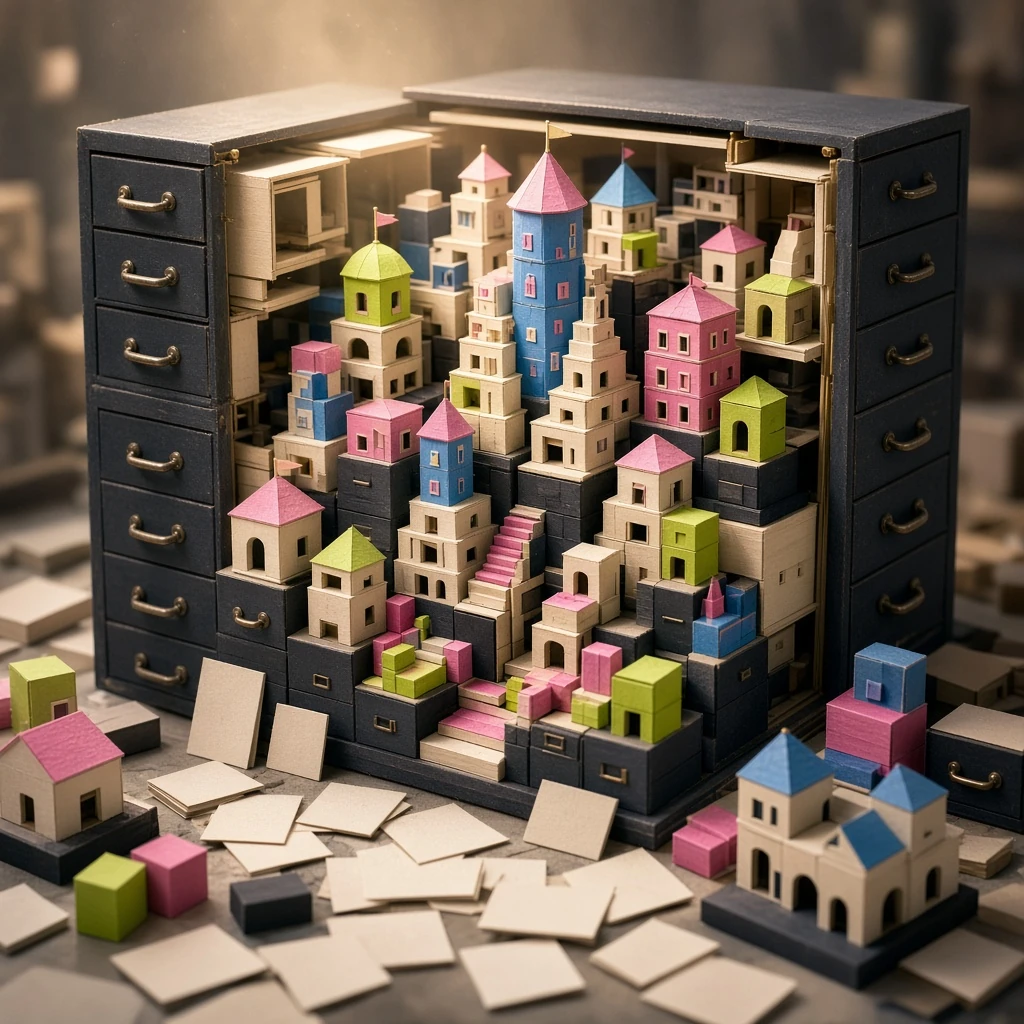
When every building option appeared at once, the editor resembled a supermarket aisle for architecture: forty roofs, fifteen lobby moods, and a chimney shaped like a question mark that had no known manufacturer.
Midge Pritchard, art director for pavement, rooftops, and unnecessary atmosphere took the first call because a catalog mistook abundance for hospitality and buried choice beneath choice. The official alarm was a brass desk bell that has no electrical connection to anything, but it has excellent posture and has never missed an opportunity to make a situation sound civic.
Midge Pritchard set the cards on a long table while Ira Bracket tried to sort them by what a player actually needed next. Dot Oxbow counted the roofs and stopped at twenty. Meryl Gannet searched for the question-mark chimney’s safety documentation and found only an apology in the margins.
Testers started selecting the first plausible card just to escape the list. One person built a structure from three incompatible styles and called it a coping mechanism. The catalog responded by offering them six more trim packages.
The incident reached the weekly coordination table, where one chair is always empty for the person currently trapped in a loading screen. The notes were severe, the coffee was not, and the working conclusion was that a city may be peculiar without making a player responsible for decoding its paperwork.
The editor learned progressive disclosure: choose a lot, choose a family, then tune the few details that make a real difference. The result retains variety without asking a player to speed-run an industrial warehouse before they can place one humane building.
The repair was tested the unglamorous way: slowly, repeatedly, and with someone assigned to ask what happens if a player does the sensible thing twice. The city survived that question, which is a modest achievement by engineering standards and a miraculous one by the standards of office folklore.
The Catalog Courtesy Rule says power should arrive in the order it becomes useful. A builder deserves meaningful choices, not a ceremonial avalanche of roof shapes and a chimney that appears to be asking whether it belongs.
In the end, the practical question stayed usefully small: what does a player think will happen next, and are they right for a satisfying reason? Every committee, memo, kettle, and unsafe-looking clipboard in this report existed to defend that modest piece of dignity.
The team repeated the walk at different speeds, from different corners, and with the kind of harmless curiosity that causes software to disclose whether it has actually thought about people. A solution had to work before the joke, during the joke, and after someone wandered off to inspect a lamp.
A modest notice went onto the internal board beside the weather schedule and the emergency biscuit inventory. It is less glamorous than a victory lap, but it prevents good fixes from becoming oral tradition, where they eventually acquire capes, supporting animals, and a completely false origin story.
The serious work hides behind the silly headline: clear intent, stable state, readable space, sensible limits, and enough personality that the result feels like it belongs to this city rather than a spreadsheet with better lighting. The headline simply helps everyone remember where the rule came from.
Before closing the file, the crew described the outcome in the language of a player rather than the language of the room that fixed it. That translation matters. A person entering the city should inherit the confidence of the repair, not the homework assignment of understanding every delightful failure that made it necessary.
The next block will likely present a different nuisance wearing a different hat. When it does, the team will have this report, its absurd precedent, and a practical question ready: what does the place promise, and how can it keep that promise without losing its peculiar grin?
The finished note sits in the archive between a map fragment and a receipt for replacement biscuits. That placement feels right. Development is part careful record and part evidence that somebody stayed in the room long enough to ask whether the odd thing was funny, functional, or quietly both.
Midge Pritchard filed the last page under resolved, which in Build Pit language means working, understood, and still faintly ridiculous. That is a strong outcome. The city gets a dependable corner; the team gets a story; the emergency biscuit tin gets a well-earned quiet afternoon.